Running a minor hockey tournament is one of the most satisfying volunteer jobs in the rink, once it is over. Before that, it can feel like you have temporarily become an event planner, scheduler, accountant, referee liaison, travel agent and IT help desk.
Separate planning from tournament-weekend operations. Build the schedule, rules and communication system early, then give people real roles so the weekend is about running the plan and handling the changes that always come.
1 Decide what kind of tournament you are running
Start with purpose: division, competitive level, number of teams, game guarantee and format. A U11 community Christmas tournament has different needs from a U18 AA showcase or a U9 jamboree. Do not copy last year's schedule simply because it exists.
Choose the field size only after you know the ice. It is much easier to run an excellent eight-team tournament than a chaotic ten-team tournament squeezed into the same weekend.
2 Start sanctioning ice and officials early
For Hockey Canada-sanctioned minor hockey, the event must follow the applicable Branch and local association process. In Alberta, host tournaments require sanctioning through the MHA/Hockey Alberta pathway; Calgary teams use Hockey Calgary's tournament process. Out-of-province teams need the appropriate permission/travel documentation from their home Branch or association.
Officials are a real capacity constraint. Hockey Calgary's guidance explicitly warns that an out-of-town tournament can be cancelled if the local assignor cannot staff it. Treat referee availability like ice availability: confirm it before you build assumptions around a date.
3 Build a realistic budget
- Ice and floods
- Officials and assigning fees
- Sanction/administration costs
- Awards and player-of-game items
- Printing/signage/supplies
- Payment-processing costs if applicable
- Hospitality for volunteers/officials
- Contingency for a late team withdrawal or extra ice need
Set the entry fee from the budget, not from "what other tournaments charge." Then tell teams exactly what the fee includes. If fundraising, raffles or 50/50 are part of the plan, follow the applicable provincial gaming rules and your association's policies.
4 Recruit teams at the right level
Competitive balance is part of tournament quality. Make the level clear in the listing, and ask enough questions to avoid obvious mismatches. For Western Canadian events, do not assume provincial tier labels convert directly. Alberta, B.C. and Saskatchewan categorize teams differently.
A well-matched field produces close games, less frustration and a better chance teams return next year. It is worth more than filling the last spot instantly.
5 Pick a format families can understand
Small fields can use a full round robin. Larger events usually need pools, crossover semifinals, seeded playoffs or A/B/placement games. Hockey Saskatchewan's hosting guidance recommends deciding tournament format, overtime, tie-breaks, home-team process, mercy rule and playoff format before registration is complete.
Write the rules in plain language. If the committee cannot explain who advances without opening a spreadsheet formula, simplify it.
6 Build the schedule around players
Set minimum rest, daily game limits and locked championship slots before placing games into the available ice. Balance early and late starts, include arena transfers, and check every possible semifinal and final path. A sensible schedule makes meals, volunteers, officials and team communication easier to manage.
Avoid publishing until the field and ice are truly stable. A "final v7" PDF is how two teams eventually arrive for the same dressing room.
7 Divide the weekend into operating roles
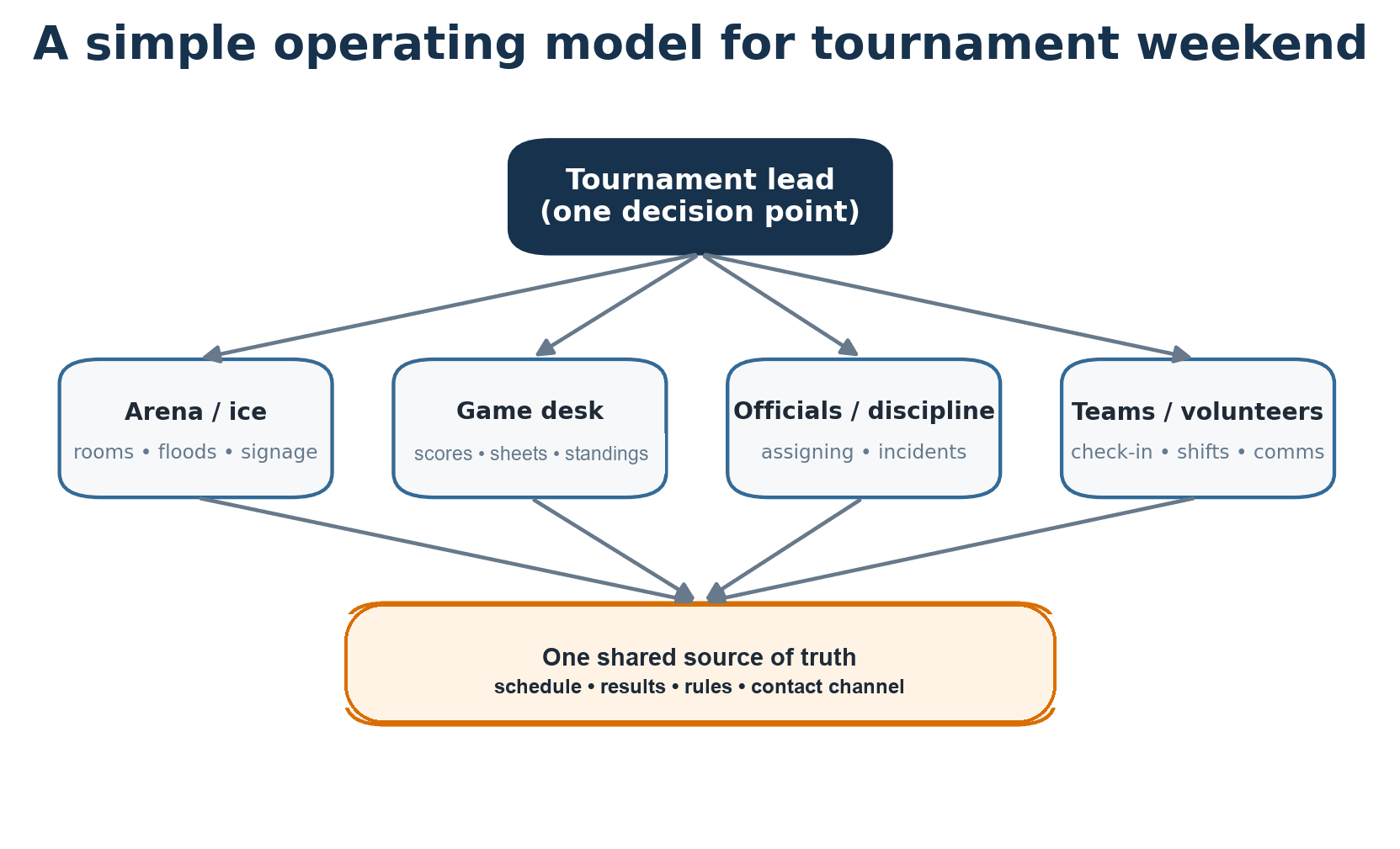
One tournament lead should own decisions, but that person should not run the clock, answer every manager text and update standings. Create clear leads for arena/ice, game desk, officials/discipline, and teams/volunteers. Give each lead the authority to solve routine problems within their area.
Use one shared schedule/results/rules location. If the public web page says one thing and the arena wall says another, the arena will win, and the group chat will explode.
8 Communicate before teams need to ask
Send a manager package about a week before the event with:
- final schedule and arena addresses
- rules and tie-breakers
- check-in/roster requirements
- home/away and sweater-colour process
- dressing-room information if known
- score/standings link or location
- emergency/tournament contact method
- parking, food and local notes that matter to travelling families
The tone matters. Parents and managers are volunteers too. Clear, friendly instructions prevent far more friction than a long rulebook written like a legal notice.
9 Plan for predictable problems
| Problem | Decide in advance |
|---|---|
| Team withdraws | waitlist, refund rule, revised-format authority |
| Game runs late | curfew rule, flood decision, next-game communication |
| Suspension/incident | who receives report and who contacts Branch/league designate |
| Tie-break dispute | published rule is final; identify decision authority |
| Jersey colour conflict | home/away rule and spare-pinnie process |
| Weather/travel issue | delay/cancellation threshold and communication channel |
| Volunteer no-show | backup list or lead authorized to reassign shifts |
10 Close the tournament properly
After the medals are handed out, complete the branch and local reporting, reconcile bills and gaming reports, thank the volunteers and write down lessons for next year. Alberta requires the Tournament Discipline Report, game sheets and incident reports within 24 hours. Hockey Saskatchewan currently requires its game sheets and tournament report within 72 hours.
How TourneyFindr can fit into the workflow
TourneyFindr brings several scattered jobs together. Organizers can claim or create a listing, teams can search by division, tier, date and location, Tournament Builder can generate schedules and brackets from the ice and rules, and the organizer space can track Team Passport applications. The public listing and organizer workflow stay connected.
The platform is based in Okotoks, so the product is being built around the way Western Canadian minor hockey actually runs: volunteer-heavy, geographically spread out, full of local terminology, and held together by people who are doing this after work because their kids love hockey.
The measure of a successful tournament
Something will change during a live event. A successful tournament still gives the kids good games, keeps teams informed, gives volunteers manageable jobs and lets the organizers solve surprises without throwing the whole weekend off course.
When teams leave saying, "That was well run. We'd come back," the tournament did its job.
Sources and further reading
Rules and policies change. Before registering, travelling or publishing a schedule, confirm the current requirements with your provincial branch, league and local minor hockey association.
- Hockey Alberta - Tournaments / sanctioning
- Hockey Alberta - Coach/Manager Discipline Handbook
- Hockey Alberta - Tournament Discipline Reports
- Hockey Calgary - Hosting a Tournament FAQ
- Hockey Saskatchewan - Tournament Host Resource Guide
- Hockey Canada - U9 FAQ: tournament and jamboree definition
- TeamSnap - How to Effectively Organize a Hockey Tournament