Tournament format sounds like organizer jargon until you are trying to explain to twelve families why a 2-1 team is playing in the B final. A good format should be easy to describe, fair enough for the age group, and realistic for the ice you actually have.
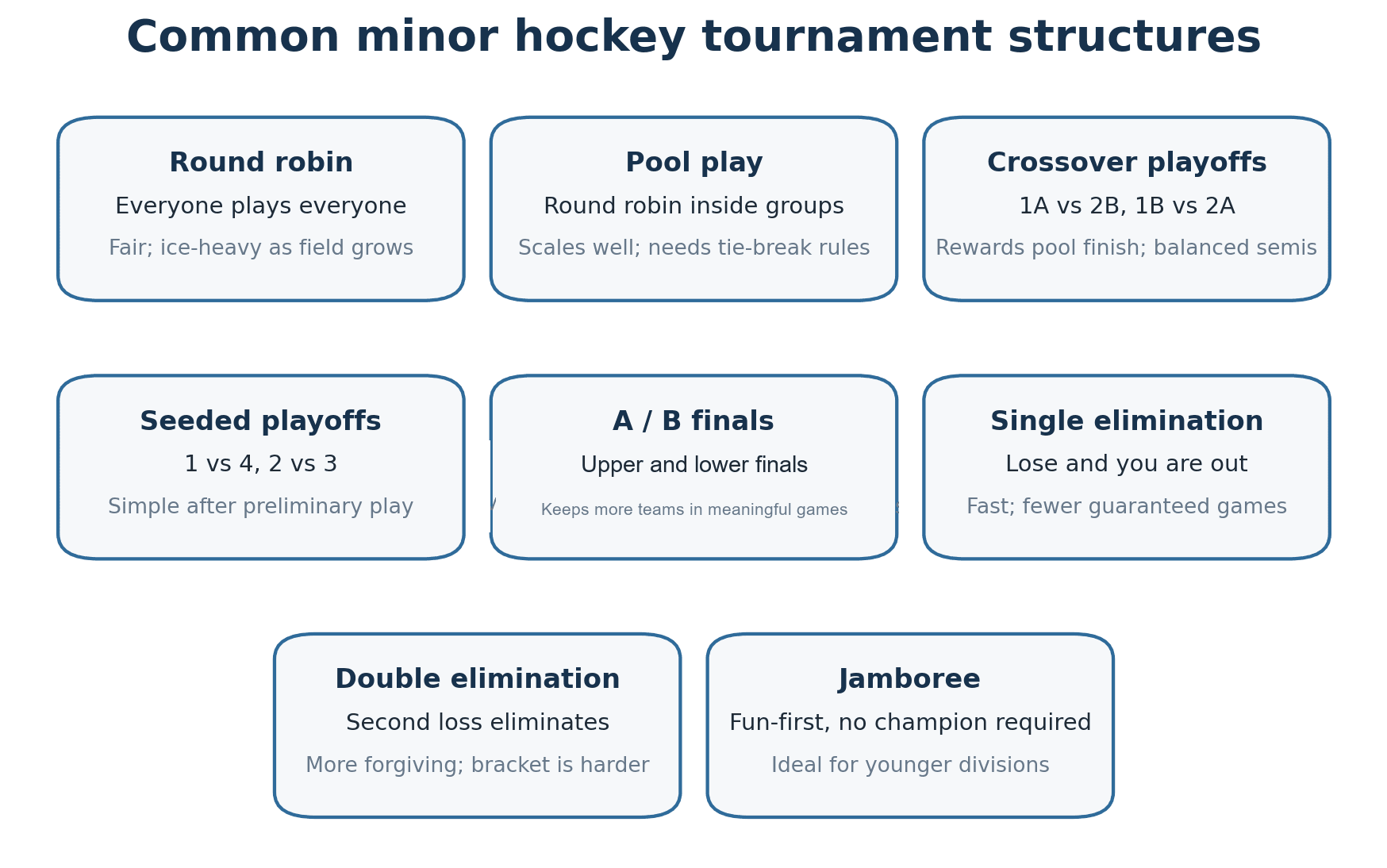
Round robin
In a true round robin, every team plays every other team once. Hockey Canada's tournament-structure resource defines it this way, and the math is straightforward: with n teams, the number of games is n(n-1)/2. Four teams need six games; five teams need ten; six teams need fifteen.
A round robin is fair for a small field because everyone faces the same opponents. It becomes hard on ice time once the field grows beyond five or six teams.
Pool play
Pool play divides the field into smaller groups, then runs a round robin inside each pool. An eight-team event might use two pools of four. Each team gets three preliminary games without requiring all 28 games of an eight-team full round robin.
The trade-off is that teams do not face identical opponents, so the pool design and tie-break rules matter. If the pools are badly unbalanced, the playoff seeding can feel unfair.
Crossover semifinals
Crossovers are common after two pools. The usual pattern is 1st in Pool A vs 2nd in Pool B, and 1st in Pool B vs 2nd in Pool A. The winners meet in the final. This rewards winning the pool without forcing an immediate rematch against a team you already played.
Hockey Alberta uses this type of structure in several playoff formats, and it is a clean choice for eight-team events.
Seeded playoffs
Instead of crossovers, all teams can be ranked after preliminary play and seeded into a bracket: 1 vs 4 and 2 vs 3, for example. Seeding works well when every team has played a reasonably comparable preliminary schedule. If pools were very different in strength, a combined 1-8 ranking can create arguments unless the rules are explicit.
A and B finals and consolation brackets
An A and B final structure gives more teams a meaningful last game. The upper half of the standings advances to the A side, while the lower half plays on the B side or for a consolation championship. For community minor hockey, this often makes better use of a family's weekend than eliminating half the field after one playoff game.
Do not make the B side feel like a punishment. Give it a clear name, a proper final slot and the same level of organization as the A side.
Placement games
Placement games match teams based on preliminary results, 5th vs 6th, 7th vs 8th, and so on. They are simple, guarantee more hockey and reduce the number of teams sitting around Sunday morning with nothing to do. They can also be combined with semifinals and a championship game.
Single elimination
Single elimination is the classic bracket: lose once and you are out. It uses ice efficiently and creates obvious drama, but it is usually a poor stand-alone format for a community minor hockey weekend because one bad game can end a team's tournament after a long trip. It works much better after guaranteed preliminary games.
Double elimination
In double elimination, the first loss moves a team to a lower side of the bracket; the second loss eliminates it. This offers more forgiveness than single elimination but is harder to explain, schedule and publish. It is best when the organizer is comfortable managing bracket dependencies and has flexible ice.
Jamboree
Hockey Canada distinguishes a jamboree from a tournament. A jamboree is fun-first: players may be mixed onto teams, games may or may not be competitive, and the emphasis is participation rather than producing an eventual champion. That makes jamborees especially appropriate in introductory age groups.
Choosing a tournament format
| Situation | Usually a good fit | Why |
|---|---|---|
| 4 teams | Full round robin + final/placement | Simple and fair; only six preliminary games |
| 5 teams | Full round robin + final | Everyone gets four prelim games; 10-game round robin |
| 6 teams | Two pools of 3 plus crossovers or placement games | Controls ice demand |
| 8 teams | Two pools of 4 + crossover semifinals | Common, scalable and easy to explain |
| Large multi-division event | Pools + seeded playoffs/placement | Lets each division share limited ice |
| U7/U9 fun-first event | Jamboree/festival structure | Development and participation over standings |
A format is only as good as its rules package
Before registration opens, publish the points system, tie-breakers, overtime rules, mercy rule, home/away process and exactly how teams advance. Hockey Saskatchewan's hosting guide specifically recommends deciding these items in advance. If parents need a whiteboard demonstration on Saturday night to understand Sunday qualification, the format is probably doing too much.
How TourneyFindr can help organizers
TourneyFindr Tournament Builder supports these common structures. An organizer can choose a format, enter the available ice, set rest and daily game limits, and generate a schedule that checks those constraints. Choose the format for the teams and ice you have, then let the bracket follow that decision.
Sources and further reading
Rules and policies change. Before registering, travelling or publishing a schedule, confirm the current requirements with your provincial branch, league and local minor hockey association.