"Round robin" and "pool play" are often used as if they are opposites. They are not. Pool play is simply a way to shrink a round robin when the tournament has too many teams to make everyone play everyone else.
Why full round robins are great for small tournaments
A full round robin is hard to beat for four or five teams. Everyone faces the same field, standings are easy to understand, and one unusually easy or difficult pool cannot distort qualification. A four-team round robin needs just six games; a five-team round robin needs ten.
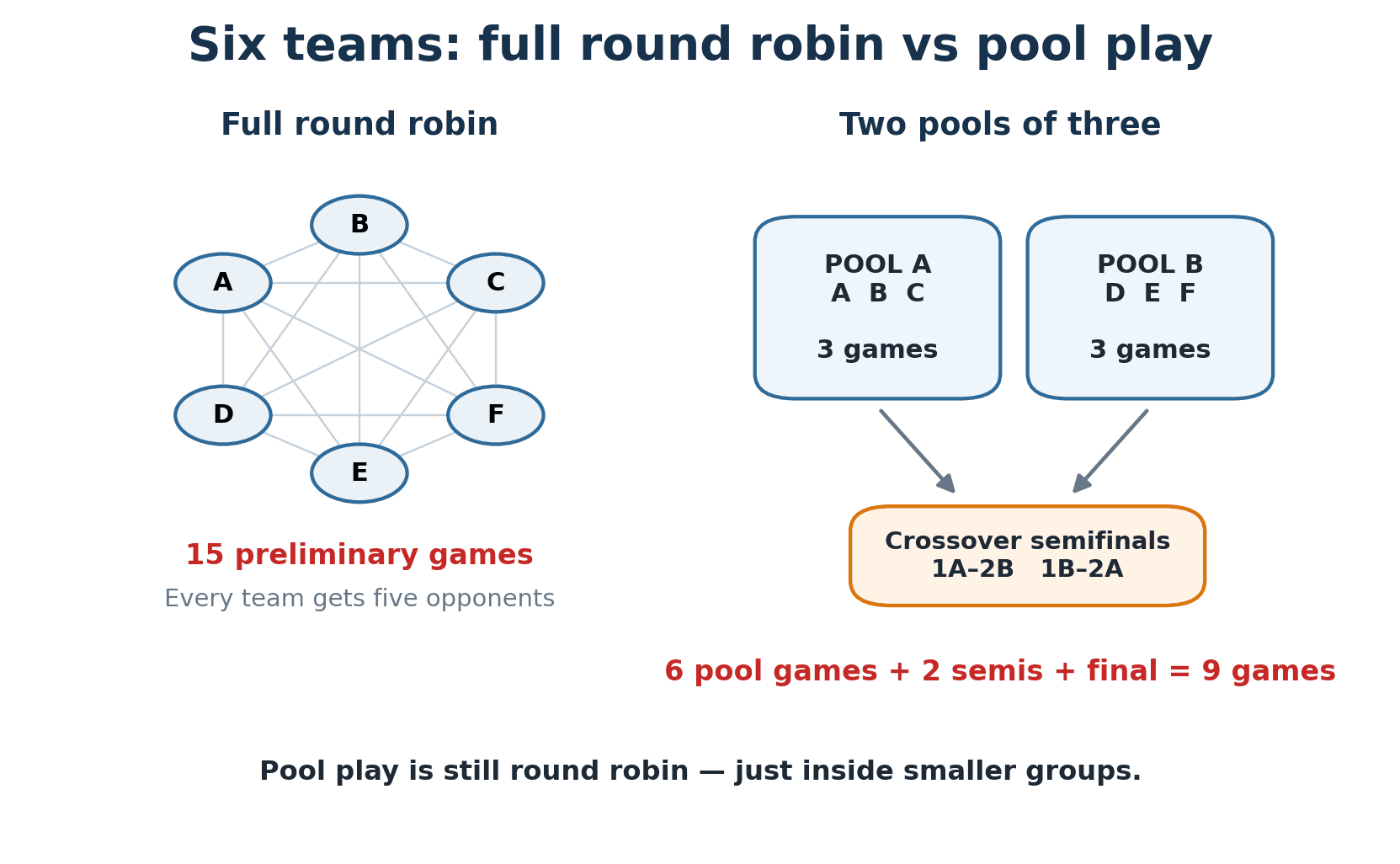
The game count is n(n-1)/2. That formula is the reason the format stops scaling. Six teams need 15 games, eight teams need 28, and ten teams need 45 before you have even played a semifinal.
Why pool play exists
Pools trade a little competitive symmetry for a lot of scheduling efficiency. Eight teams split into two pools of four require 12 pool games rather than 28 full-round-robin games. Add two crossover semifinals and a final and you have a 15-game championship path that still gives every team three preliminary games.
That leaves room for placement or B-side games without turning the weekend into a 6 a.m. to midnight marathon.
The biggest pool play risk unbalanced groups
If one pool accidentally contains three of the four strongest teams, the standings will not reflect the field cleanly. Organizers can reduce this by using prior-season or current-season information to seed pools, separating known top teams where appropriate, and avoiding obvious same-league rematches when the goal is a new tournament experience.
Early-season seeding data may be thin. Use the available league placement and recent results, then publish straightforward qualification rules.
Tiebreakers matter more in pools
Small pools create more chances for equal records. Publish the tie-break sequence before the tournament starts and keep it simple. Common approaches use wins/points first, then head-to-head where appropriate, then a goal-based measure with sensible caps. Do not change the tie-breaker on Sunday morning because a result looks odd.
Choosing between round robin and pool play
| Field size | Usually best | Comment |
|---|---|---|
| 3 teams | Double round robin or custom series | A single round robin gives only two games each |
| 4 teams | Full round robin | Six games total; very clean |
| 5 teams | Full round robin | Ten games; four opponents each |
| 6 teams | Pools or partial round robin | Full round robin jumps to 15 games |
| 8 teams | Two pools of four | A Western Canadian tournament classic |
| 10+ teams | Multiple pools/divisions | Usually needs careful seeding and placement structure |
A practical eight team format
- Two pools of four; three pool games per team.
- 1st A vs 2nd B and 1st B vs 2nd A in crossover semifinals.
- Semifinal winners play the championship.
- 3rd A vs 3rd B and 4th A vs 4th B can be used as placement games, or the lower four can feed a B-side bracket.
- Give teams enough rest so a Sunday semifinal winner is not rushed straight into the final.
Where TourneyFindr Tournament Builder helps
TourneyFindr Tournament Builder connects the format to the available ice. After the organizer chooses a full round robin or pools, it calculates the games, checks the ice slots, enforces rest and daily game limits, and keeps semifinal or final slots fixed where required.
What to remember
Use a full round robin when everyone can reasonably play everyone. Use pools when the field is larger and you need guaranteed games without using every available hour of ice. Choose the option you can schedule fairly, explain quickly and run without exhausting players or volunteers.
Sources and further reading
Rules and policies change. Before registering, travelling or publishing a schedule, confirm the current requirements with your provincial branch, league and local minor hockey association.