Rest is one of the easiest ways to tell whether a tournament schedule was built for kids or simply squeezed into the available ice. Families notice it immediately: enough time to change, eat, hydrate and settle down feels normal; a rushed turnaround feels like the entire weekend is happening in the dressing room parking lot.
The tricky part is that "minimum rest" is not standardized across all of Canadian minor hockey. Organizers need to know the governing rule and decide what quality standard they want for their own event.
What Western Canadian guidance actually says
Hockey Calgary's current tournament guidance says teams may not be scheduled for more than three games in one day. When three games are required, the games must be no longer than 75 minutes and teams must have at least one and a half hours between the second and third games. Calgary also says tournament schedules should be reasonable for the age category and location of the teams.
Salmon Arm Minor Hockey's 2025-26 tournament guide tells organizers to allow adequate time between games and says two hours or more is best when possible. Hockey Calgary uses a different minimum for a specific three-game day. Check the authority sanctioning your event rather than assuming one number applies everywhere.
Measure rest from the final buzzer
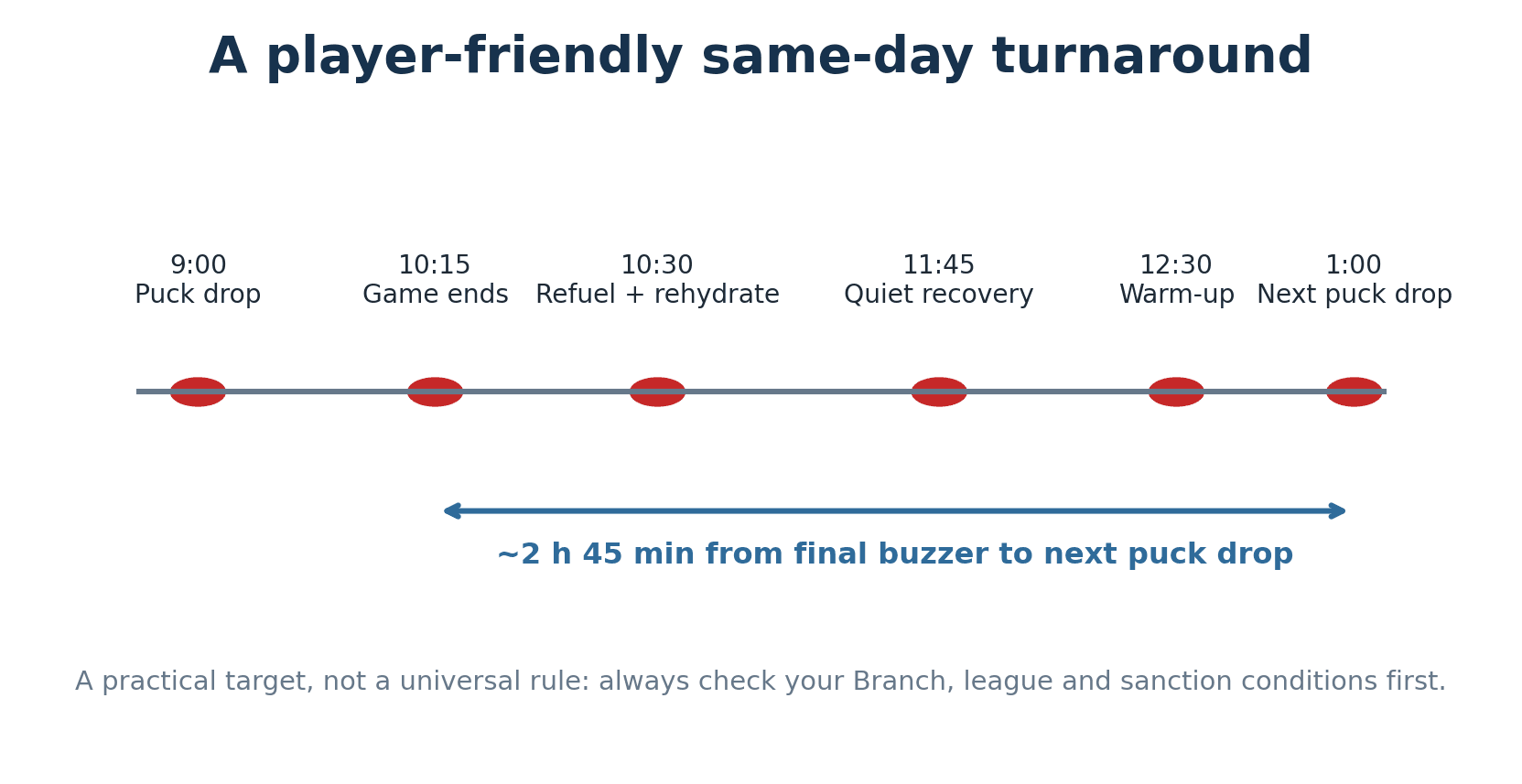
When someone says "three hours between games," ask what that means. Three hours from puck drop to puck drop is very different from three hours from final buzzer to next puck drop. A 75-minute game with a three-hour start-to-start interval leaves only about 1 hour 45 minutes between games, before you subtract changing, team meetings and warm-up.
For a player-friendly schedule, measure the usable off-ice recovery time between the final buzzer and the next warmup.
What players are doing during the break
Players need time to cool down, change out of wet gear, drink, eat, settle mentally and prepare again. A 2023 study of 16 male Danish U20 national-team players found reduced muscle glycogen and muscle function after a game, with full recovery measured one to two days later. That small elite sample does not set a rest rule for a community U13 tournament, but it does show why a short turnaround should not be treated as empty time.
A practical scheduling standard
| Situation | Planning recommendation | Why |
|---|---|---|
| Two games in a day | Aim for at least 2 hours end to start when ice allows | Leaves usable time for food, hydration and a reset |
| Three games in a day | Avoid where possible; follow local rule strictly | Fatigue and logistics stack quickly |
| Semifinal → final | Give one of the longest gaps of the weekend | Do not punish a team for winning the semi |
| Late game → early game | Avoid very short overnight turnarounds | Sleep is part of recovery |
| Younger divisions | Allow extra time where possible | Families need time for meals, gear and settling between games |
The first line in the table is a planning target, not a Hockey Canada rule. Follow any stricter branch, league or sanction requirement. When the rule permits a shorter break, organizers can still allow more recovery time if the ice is available.
Give both finalists enough recovery
A common schedule mistake is putting both semifinals on Sunday morning, then giving the winner of the later semifinal very little time before the championship. If possible, stagger the semis carefully or schedule the final late enough that both possible finalists receive acceptable rest. The same principle applies to B finals and placement games.
Food and hydration are part of the schedule
A break is only useful if families can use it. If teams have to drive 25 minutes to a second arena and then find lunch, a two-hour gap disappears quickly. When possible, cluster a team's same-day games at one facility or build transfer time into the constraint. Send nearby food options in the manager package, and keep the schedule stable enough that team meals can actually happen.
How Tournament Builder can enforce rest automatically
TourneyFindr Tournament Builder lets organizers set minimum rest in minutes and a maximum number of games per team per day. The generator rejects assignments that break those limits, which removes a conflict volunteers can easily miss in a spreadsheet.
What to remember
Start with the rule that governs your event. Then, if the ice allows, schedule beyond the bare minimum. A tournament is better when teams have enough time to eat, laugh, reset and come back ready to play. That is good for the hockey, good for the families, and usually good for the officials and volunteers too.
Sources and further reading
Rules and policies change. Before registering, travelling or publishing a schedule, confirm the current requirements with your provincial branch, league and local minor hockey association.
- Hockey Calgary - Tournament FAQ: scheduling guidelines
- Salmon Arm Minor Hockey - 2025-26 Tournament Guide
- Hockey Alberta - Provincial Host Bid Guidelines / sample schedules
- Thorsteinsson et al. 2023 - recovery of muscle function and glycogen after elite youth ice hockey
- Sport Manitoba - High Performance Recovery Nutrition and Hydration