Building a hockey tournament schedule is a small operations problem disguised as a spreadsheet. You are balancing ice, team availability, minimum rest, officials, dressing rooms, travel, locked championship slots and a format that may depend on earlier results. The good news is that the work becomes much easier when you solve it in the right order.
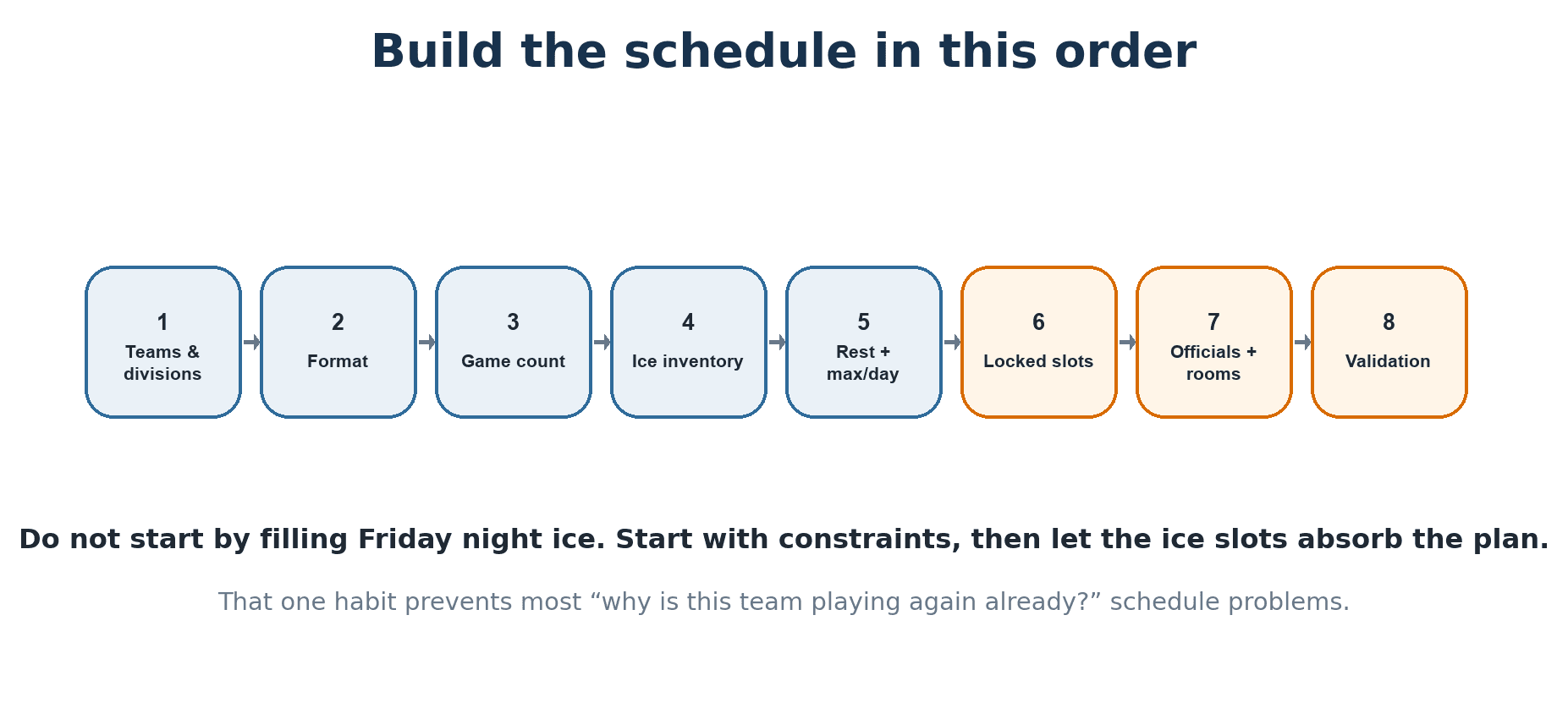
Step 1 Lock the tournament inputs
Before you schedule anything, freeze the basics: divisions, number of teams in each division, tournament format, game length and guaranteed games. If you are still accepting a possible ninth team, build a second scenario instead of pretending the eight-team schedule will somehow stretch.
Step 2 Calculate the game count
For a full round robin, use n(n-1)/2. For pools, calculate each pool separately and then add crossovers, playoffs, finals and placement games. This gives you the minimum number of game slots the tournament must support.
Example: eight teams in two pools of four = 6 games per pool, 12 preliminary games total. Add two semifinals and a final and you need 15 slots. Add two placement games and a B final and you are at 18.
Step 3 Build an ice inventory
List every usable slot by rink, date, start time and duration. Include floods, ice cleaning and hard facility boundaries. If two arenas are ten minutes apart, include transfer time, especially when volunteers, coaches or officials move between them.
Step 4 Set hard constraints before preferences
| Hard constraint | Typical example |
|---|---|
| Minimum rest | No team plays again until the required/target recovery window has passed |
| Maximum games/day | Set from the governing rules; two is a sensible target where the ice permits |
| Locked ice | Championship game Sunday at 3:30 p.m. |
| Team blackout | Out-of-town team cannot arrive before Friday 6 p.m. |
| Division rule | U11 game length differs from U15 |
| Officials | Qualified crew must exist for the level and slot |
Then add soft preferences: host team on Friday evening, avoid 7 a.m. starts for the farthest traveller, spread a team across both rinks, avoid same-association rematches, or keep the championship in the feature arena. Hard constraints cannot be broken. Soft preferences can be traded off.
Step 5 Schedule backward from dependent games
Finals and semifinals are the least flexible because they depend on earlier results and often occupy premium Sunday ice. Lock those first. Then make sure the semifinal winners have enough recovery before the final. Work backward into Saturday's last preliminary games and only then fill the earlier rounds.
Step 6 Balance the team experience
A schedule can be technically valid and still be miserable. Look for teams receiving the 7 a.m. start and the late game, long arena transfers, a three-game day followed by an early morning, or a team playing all of its games at the secondary rink. Fair does not mean identical, but the inconvenience should be shared.
Step 7 Validate every schedule path
- No team appears in two places at once.
- Every team receives the promised number of preliminary/guaranteed games.
- Rest rules are satisfied for every possible playoff path, including unlikely combinations.
- No team exceeds the allowed games per day.
- Officials and dressing rooms are workable.
- Standings can be calculated before the dependent playoff slot needs to start.
- Ice floods, ceremonies and awards are included in the clock, not added as an afterthought.
- The host has a contingency slot or plan for delays, if possible.
A small sample schedule
| Time | Rink 1 | Rink 2 |
|---|---|---|
| Fri 5:00 | Pool A: A1-A2 | Pool B: B1-B2 |
| Fri 6:30 | Pool A: A3-A4 | Pool B: B3-B4 |
| Sat 9:00 | A1-A3 | B1-B3 |
| Sat 10:30 | A2-A4 | B2-B4 |
| Sat 2:00 | A1-A4 | B1-B4 |
| Sat 3:30 | A2-A3 | B2-B3 |
| Sun 9:00 | Semi: 1A-2B | Semi: 1B-2A |
| Sun 2:00 | Championship | Placement / B-side |
The exact times above are only an illustration. Your game length and required rest determine the real spacing.
Where TourneyFindr Tournament Builder helps
Tournament Builder handles this constraint work. Organizers enter divisions and teams, choose a format, add ice across one or more rinks, set minimum rest and daily game limits, and lock important slots such as the championship. The generator checks the conflicts that are easy to miss in a manual spreadsheet.
The organizer still decides whether the host plays Friday night, whether a travelling team needs a later start and whether a B final is worth the ice. The builder checks the schedule created from those choices.
Publish one controlled schedule
Do not release a "final" schedule while teams or ice are still changing. Send a draft to the tournament committee and, if appropriate, a small manager group. Validate it. Then publish one source of truth and make changes only through a controlled channel. Most tournament-day confusion starts with two different PDFs circulating in two different group chats.
Sources and further reading
Rules and policies change. Before registering, travelling or publishing a schedule, confirm the current requirements with your provincial branch, league and local minor hockey association.